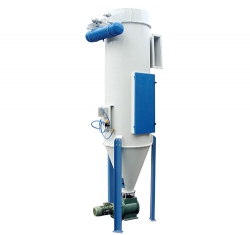
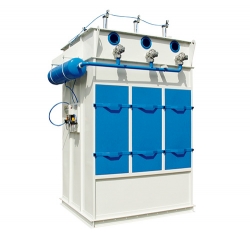
As a dust collection device with high dust removal efficiency, stable operation, low cost and convenient maintenance, the environmental protection pulse dust collector has stood out and been widely applied in an increasing number of cement plants.
(1) Crushers
Crushers in cement plants can be divided into limestone crushers, clinker crushers, etc., according to different feeding materials, and into impact type and extrusion type according to different destructive forces applied.
During operation, mechanical actions such as impact, extrusion and friction generate partial heat energy, which raises the temperature of powder but not significantly. Therefore, pulse bag dust collectors using ordinary polyester needle felt as filter material can be adopted, and the casing does not need insulation.
Impact crushers produce fine particles, and coupled with the disturbance of high-speed airflow inside the machine, the dust concentration of gas entering the dust collector can reach 100 g/m³, much higher than that of extrusion crushers (< 20 g/m³). Thus, the filtering air velocity should be set lower than that for extrusion crushers to prevent fine dust from penetrating the filter bags.
(2) Ball Mills
This includes raw material mills, steel (slag) mills, cement mills, coal mills, etc.
Most energy consumed by mills is converted into heat energy, which evaporates moisture in raw materials during grinding. When the moisture content of feed exceeds 2%, a combined drying and grinding process must be adopted, with gas temperature at mill inlet reaching approximately 350℃, mostly applied in raw material mills and coal mills.
For non-drying raw material mills, the exhaust dust concentration is 10–20 g/m³, dew point around 30℃, and waste gas temperature about 50℃, so room-temperature pulse bag dust collectors can be used.
Steel (slag) mills mostly handle dry feed and can also operate without drying, with exhaust gas temperature slightly higher than that of raw material mills.
To ensure normal operation of raw material dust collectors, especially in winter, the key is thermal insulation to prevent condensation. If necessary, a small hot blast stove can be installed at the mill outlet to raise exhaust gas temperature above 70℃.
Infiltration of cold air may bring flue gas temperature close to the dew point, causing condensation in the dust collector. Over time, filter bags will harden, deteriorating dust cleaning performance and greatly increasing dust collector resistance, which severely affects air volume of the dust removal system. Corresponding technical measures shall be taken to control the air leakage rate below 2%, with special attention to ash discharge valves at the lower part of ash hoppers, manhole doors, etc.
Exhaust temperature of drying mills is 40–50℃ higher than the dew point, higher than that of ordinary raw material mills. With good thermal insulation and low air leakage, condensation risk is much lower than that of dust collectors for ordinary raw material mills.
Cement mills process only dry materials, with low exhaust humidity, dew point around 25℃, and exhaust temperature 90–100℃, generally free of condensation risk. However, proper thermal insulation is still required in northern China due to extremely low ambient temperature in winter.
Exhaust dust concentration of ordinary cement mills is 40–80 g/m³, so a relatively low filtering air velocity should be selected.
Exhaust dust concentration of coal mills is 25–80 g/m³ with fine coal powder particles. Since coal powder-laden gas is flammable and explosive, and accumulated coal powder may spontaneously ignite under certain conditions, high-concentration coal powder collection devices shall be selected. Explosion-proof valves shall be installed on dust collectors for flameproof, explosion-proof and safe pressure relief. Anti-static blended fiber fabrics shall be used as filter materials to prevent combustion and explosion accidents caused by static electricity.
(3) Dry Precalciner Kilns and Dry Hollow Kilns
Dry precalciner kilns are widely used for new construction and renovation in China. With flue gas temperature up to 360–420℃ and exhaust dust concentration 30–100 g/m³, glass fiber pulse bag dust collectors should be selected, with an economical filtering air velocity of 0.8–1.0 m/min.
The maximum allowable operating temperature of this dust collector is 260℃, so flue gas must be cooled to about 220℃ before entering the dust collector. Cooling measures include natural/forced convection flue gas coolers, air duct heat dissipation, cold air valve regulation, etc.
Although the dust collector operates under high temperature, local areas of the outer wall may still fall below the dew point in poorly ventilated flue gas stagnation zones, so thermal insulation is still required.
Many domestic dry hollow kilns are equipped with waste heat power generation boilers. Flue gas temperature is generally stable at 200–240℃, with dew point around 35℃. Glass fiber pulse bag dust collectors can be directly used without flue gas cooling, but thermal insulation is required.
(4) Raw Material Storage and Transportation
Raw materials in cement plants are stored in stockyards and silos. Cement plants with conditions should install canopies over stockyards for rain protection, to avoid waste of drying heat energy, hardening and failure of dust collector filter bags, and unnecessary economic losses.
According to material types, storage silos are classified into raw material silos, raw material homogenizing silos, clinker silos, cement silos, etc.
Material intake brings air into storage silos, creating positive pressure and causing dust emission at vent openings on silo tops. Single-unit pulse bag dust collectors can be directly installed on silo tops, or air ducts can be connected between silos. No ash hopper is installed under the dust collector; dust on filter bags falls back into the silo naturally after pulse jet cleaning.
Storage silos may hold dry materials, wet materials or mixed materials separately, resulting in different moisture contents of discharged dust. Except for silos storing only dry materials, water-proof and anti-condensation filter materials should be used for single-unit dust collectors, and casing insulation is recommended for northern regions.
In addition, due to their small size, single-unit dust collectors mostly adopt 1-inch right-angle jet valves with jet pressure of 0.40–0.60 MPa, different from ordinary dust collectors using 2.5–3-inch straight-through jet valves with jet pressure of 0.15–0.25 MPa.
Raw material transportation includes belt conveyors, screw conveyors, bucket elevators, etc.
Belt conveyors are open-type; single or double-layer enclosed hoods with exhaust hoods can be installed at discharge points.
Screw conveyors and bucket elevators are enclosed; small, firmly sealed units generally generate no dust. Large bucket elevators produce intense dust at material inlets, so exhaust hoods can be installed above feeding points.
Pulse bag dust collectors can be arranged by plant layout or dust properties to partition treatment zones for dust removal. Single-unit pulse bag dust collectors can also be directly used at belt conveyor transfer points for on-site dust collection, with cleaned dust discharged back onto the belts.